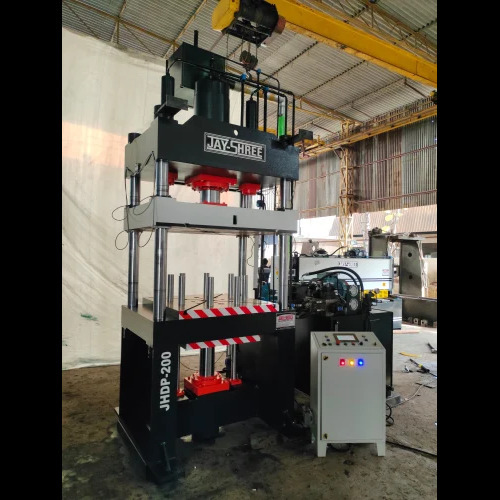
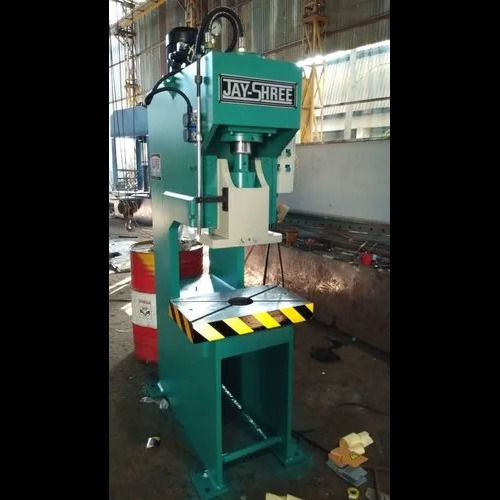
4 Pillar Hydraulic Press About
Product details
|
Capacity
|
More than 200 tons
|
|
Automation Grade
|
Fully Automatic
|
|
Voltage (V)
|
240
|
|
Material
|
Stainless Steel
|
|
Usage/Application
|
Industrial
|
|
Automatic Type
|
Automatic
|
We are one of the leading manufacturer of Hydralic & mechanical Sheet metal Cutting & bending Machinery in India. Designed using the latest techniques and premium quality spare parts, these machines are appreciated foe their fast and effective applications. Designed to suit that varied needs of our clients, these are manufactured in compliance with national and international standards of quality
Precision Engineering for Diverse ApplicationsThis hydraulic press is meticulously constructed to handle demanding tasks such as metal forming, deep drawing, moulding, and compaction. Its four-pillar design provides stability, making it suitable for heavy-duty industrial operations while maintaining accuracy and consistency in results.
Advanced Control Systems and Safety FeaturesOperators can choose between PLC-based automation and manual controls, tailored to their production requirements. Essential accessories, including pressure gauge, electric control panel, and foot switch, ensure easy monitoring and safe operation, supporting users in both semi-automatic and automatic environments.
Flexible Capacity and Robust ConstructionWith tonnage options from 30 to 200 tons, this press accommodates a wide range of job complexities. Made from high-quality mild steel and featuring paint-coated surface finish, it guarantees durability and resistance to wear, even in rigorous manufacturing settings.
FAQ's of 4 Pillar Hydraulic Press:
Q: How does the four-pillar frame benefit the hydraulic press operation?
A: The four-pillar frame design offers exceptional structural stability, ensuring uniform force distribution and precise alignment during pressing operations, which is essential for tasks like metal forming and deep drawing.
Q: What materials can be processed using this hydraulic press?
A: This press is primarily built for metal processing, including steel, aluminum, and other alloys. Its robust capacity also supports operations involving moulding and compaction of composite and synthetic materials.
Q: When is it preferable to use the PLC-based control system versus manual operation?
A: PLC-based control is ideal for automated, high-volume production that requires consistent and programmable controls. Manual operation suits lower volume or specialized processes needing direct handling or flexibility.
Q: Where is the hydraulic press commonly installed for optimal usage?
A: It is best placed in industrial environments such as manufacturing plants, fabrication workshops, and toolrooms, where infrastructure supports the machine's power, space, and safety requirements.
Q: What is the process for performing deep drawing with this press?
A: Deep drawing involves placing the sheet metal on the die, setting the desired pressure, and activating the hydraulic ram. The press then forms the material into the desired shape with precision, leveraging its controlled ram stroke and stable support.
Q: How does the automation grade enhance productivity and safety?
A: The semi-automatic/automatic automation grade reduces manual intervention, optimizes cycle times, and integrates safety interlocks, minimizing human error and improving overall efficiency.
Q: What advantages does the large daylight gap provide during operation?
A: A substantial daylight gap allows accommodation of bigger workpieces or tools, enhancing versatility for various forming processes and simplifying setup and removal tasks.





 Send Inquiry


 Send Inquiry